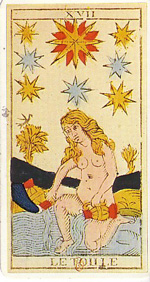


The archetypical Tarot of Marseille, made by Nicolas Conver in his Marseille workshop in the middle of the 18th century, served as a model for the editors Lequart and Grimaud when they proposed a playing tarot in about 1890. Paul Marteau later based his 1930 symbolic tarot on their work.
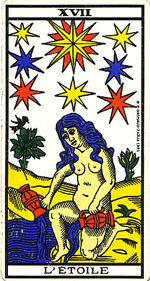
Paul Marteau presented himself as a simple restorer, but in aligning himself with the esotericism of his time he in fact produced an original version. A comparison with Conver’s 1760 Tarot, which Marteau claimed to reproduce, provides unequivocal proof of this. Edited in several languages, Marteau’s tarot owed its global success as much to the huge distribution effort of his editor as to the skill of the “restorer”.
Today the Marteau remains the best-selling Tarot of Marseille, the one most employed in divination. This is largely due to its availability and to the fact that few tarot enthusiasts in our time recognize the importance of traditional iconography. Marteau has produced a “copy” of Convers line, but doesn’t go so far as to depict the figure in XVII the Star as pregnant. In reality she is bearing, being well situated in a creative here and now, the future of traditional knowledge and its transmission. Marteau does conscientiously reproduce the vague roll of fabric below her left knee, but surely had no idea that this (leaving the left knee “unveiled”) was one of the traditional signs of a master.
It is with respect to colours, however, that Marteau most demonstrates his ignorance of image content: light blue (the colour evoking oceanisation: the possibility of entering into the fetal mode of perception, in which we are directly connected to the world surrounding us) no longer exists, and the position and volume of the remaining shades is considerably altered. Conver, one of the last to suspect there was something to be directly apprehended through these images, depicts the young woman kneeling in the water while pouring more water into it. Arcanum XVII belongs to the stage of Mastery: this figure can now contribute to the collective pool without disturbing it. The large amount of light blue testifies to the strong presence of inspiration. Dark blue is limited to a small area, expressing the long-acquired ability to come to terms with accumulated sufferings. When we take these nuances into account, we can see to what extent Marteau’s version is non-sense. This deformed “traditional” tarot was destined to pollute most of the Marseilles versions which followed it.
Times change. Now, at the end of the 20th century, a great need for authenticity is becoming manifest. Before the incredible multiplicity of novelty or “adapted” tarots, a return to the source is imperative.
I have re-edited hand-colored versions of the major arcana of both the Noblet and Dodal tarots. An industrial 78-card Noblet deck became available in June, 2007. Respect for the tradition has guided these realizations: fidelity to the original line is paramount, as is the restitution of colors which have been degraded over time and reduced in number by the cost-cutting efforts of successive editors.